


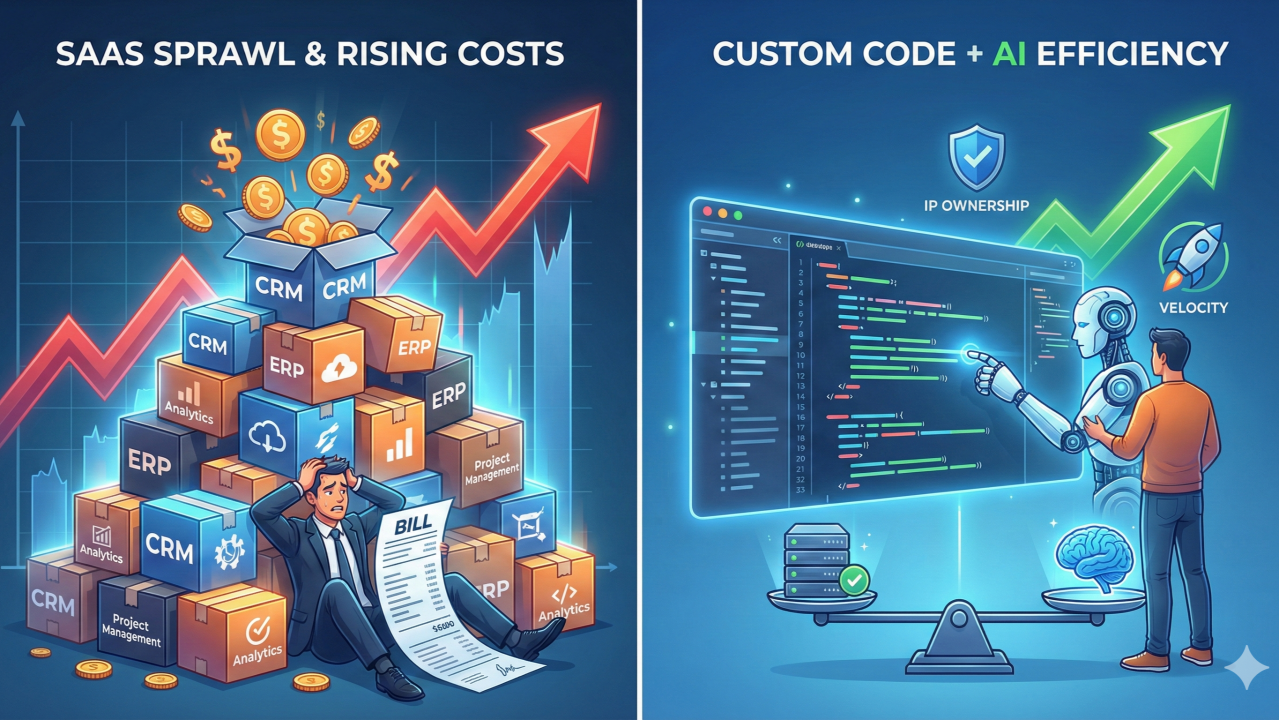
Twenty years ago, the "Cloud" was the most excellent sales pitch in the history of enterprise technology. The promise was simple: "Stop buying expensive servers. Stop paying for massive upfront licenses. Just pay a low monthly fee, and we’ll handle the rest." It was seductive. It was logical. And for a long time, it worked.
However, if you examine the balance sheet today, the "low monthly fee" has metastasized into the single largest line item in many IT budgets.
The data paints a staggering picture of this "subscription creep." In 2015, the average company used a handful of SaaS tools. By 2024, the average enterprise was juggling over 275 distinct SaaS applications. Even more alarming is the spend per employee, which has quietly climbed to nearly $5,000 per head, per year.
We are no longer paying for utility; we are paying a "SaaS Tax" on our own existence.
And it’s only getting worse. According to its latest forecast, IDC projects that worldwide software spending will increase by another 14% in 2025, driven by aggressive AI investments and price hikes. Meanwhile, Gartner predicts global IT spending will surge past $6 trillion in 2026, fueled by the rising costs of GenAI features embedded in software you already own.
For the last decade, we have layered tool upon tool, creating a fragile Jenga tower of integrations. We purchase a CRM, then a tool to report on the CRM, then a tool to sync the CRM with the ERP, and finally a tool to manage logins for all the other tools. We have accepted price hikes, vendor lock-in, and roadmap stagnation because "building it ourselves" was always seen as too slow, too risky, and too expensive.
However, by 2025, the economic gravity had shifted.
The arrival of AI and agentic frameworks has fundamentally broken the "Build vs. Buy" equation. The cost of generating code has collapsed. What used to take a team of ten engineers six months can now be prototyped by a small team in weeks. The friction of maintaining custom software—once the boogeyman of IT directors everywhere—is being smoothed away by AI agents that can document, test, and refactor code 24/7.
The premium you pay for "off-the-shelf" software is no longer a convenience fee; it’s a penalty for lack of imagination.
When you buy a massive SaaS platform today, you are renting the same capabilities as your competitors. You are paying for a thousand features you don’t use, just to access the ten you do. And crucially, every dollar you spend on a subscription is an expense that vanishes at the end of the month.
In contrast, every dollar you spend building your own AI-native workflows is an investment in an asset.
When you build your own software on a modern framework, you own the data model. You own the agentic behaviors. You own the IP. You are building a corporate IQ that resides within your walls, not on a vendor’s server in Silicon Valley.
The tables have turned. It is now often cheaper—and infinitely more strategic—to build precisely what you need than to rent a bloated approximation of it. The era of the "SaaS Sprawl" is over. The era of the "SaaS Asset" has begun.
It’s time to stop renting your future. Start building it.


.png)
.png)

.png)